
For owners
/ Who we work with
One unit, or several
Owners who want it run properly.
The service is the same whether you have one condominium or a portfolio. What changes is the coordination between units, and that is the part that scales badly.

Start here
Two ways owners arrive at this.
I own one property
A condominium you kept, bought to hold, or cannot get to. You are not trying to build a business. You are trying to stop this one becoming a second job.
I run several
Three, ten or forty units across different buildings with different declarations. The work that scales badly is the coordination between them.
For owners
/ Homeowners
The parts owners find hardest to hand over.
One property, run properly.
These are the six that come up in almost every first conversation, in roughly the order they come up.
The challenge you have
What we do about it
"I do not know what my unit is allowed to do."
The city has rules, the building has rules, and they are not the same rules. Nobody selling you management wants to be the one to tell you which ones stop you.
We answer that before we quote
The review reads your condominium declaration, the building's own rules and where the unit sits with the city, and comes back with the models it can legally run. Free, and the answer is sometimes no.
"The guest messages never stop."
Self-managing one unit means being on call. The lockout is at two in the morning, the boiler question is during your day job, and the one you miss becomes the review.
You are not in the thread at all
Every message, from the first enquiry to checkout, is ours. Not triaged to you, not escalated to you. You hear from us when something actually needs you, which is rarely.
"Turnovers eat my weekends."
Cleaners cancel, linen runs out, and the gap between a checkout at eleven and a check-in at four is yours to solve from wherever you happen to be.
Scheduled, staffed and photographed
A turnover between every stay with hotel-standard linen, restocked consumables and a photographed condition check filed each time. When a cleaner cancels it is our problem to re-staff.
"I have no idea if I am charging the right amount."
A rate set once in March is wrong by June. Set it too high and the calendar sits empty; too low and you are busy for nothing, which is the worse of the two.
Reviewed against live demand
Rates, minimum stays and seasonal floors move with demand, the city's event calendar and what comparable units in your own building are asking that week.
"Something will break and I will not know who to call."
Finding a plumber who will attend a condominium at short notice, on a Saturday, for one job, is a genuinely hard problem when you have one unit and no leverage.
A trade network that already knows the buildings
Vetted contractors booked, met on site and followed up. How spending is handled is written into your management agreement rather than negotiated in the moment.
"I never really know how it is doing."
Money arrives from several platforms on different days and none of it reconciles to anything. Whether the unit had a good month is a question you answer by feel.
One statement, and the login if you want it
Reservations, gross revenue, fees, expenses and the net paid to you, on one document each month. On commission management you also get the owner portal and can look whenever you like.
Four owners we work with most often
The accidental landlord
You moved in with someone, or moved out of town, and kept the condominium rather than selling into a market you did not like. Now it needs running and you did not sign up for that.
The investor with one unit
Bought to hold, and the yield on an unfurnished lease is thinner than the plan assumed. Furnished letting closes some of that gap if the building permits it.
The owner who is not here
Out of province or out of the country, with a unit you cannot walk into. What you need is somebody accountable on the ground and one person who answers email.
The one who has done it themselves
You have run it for a year or two, the listing has a review history worth keeping, and you have decided the weekends are worth more than the margin. We take over the listing rather than restarting it.
What handing over does not mean
Handing over the running of a unit is the part owners hesitate over, so it is worth being specific about what does not change.
- The listing belongs to you. It carries your property, your review history and your account. If we part ways, it stays with the unit rather than leaving with us
- The registration is in your name. Where the unit runs on a City registration, it is held in your name and stays with the property.
- The term is written down. How long it runs and how it ends are set out in the plan you read before you get started. Nothing rolls on by default without you knowing about it
- You are involved twice. You send the address, and later you read the plan and decide. After that the only thing that arrives is a statement each month

For owners
/ Operators
Several properties, one point of contact.
More than one unit.
Running three units is not running one unit three times. What changes past the second unit is not the work per unit, it is the overhead between them, which is where multi-unit owners quietly lose their margin.
The units stop matching
Different buildings, different declarations, different rules. One qualifies for nightly letting and the one two streets away does not, and keeping that straight in your head is where mistakes start.
Turnovers collide
Three checkouts at eleven on the same Sunday is a staffing problem rather than a cleaning problem, and it is the one that catches self-managing operators out first.
Reporting fragments
Four platforms times several units is a reconciliation job rather than a question you can answer by feel. Most operators at this size stop knowing which unit is actually carrying the others.
Models should differ
The right answer is rarely the same model on every unit. A portfolio run on one strategy is usually leaving money on some of it and taking unnecessary risk on the rest.

Assessed unit by unit, run as one portfolio
Every unit reviewed separately
One eligibility review per property, because the declarations differ. Send the addresses together and you get one document covering all of them, unit by unit.
A model per unit
Some short-term, some mid-term, and where it suits you a fixed monthly amount on the ones you would rather not think about. Mixing commercial models across a portfolio is normal.
One contact, one statement run
The same person for every unit, and statements that arrive together on the same day rather than scattered across the month.
Portfolio terms are agreed case by case. Whether managing several units changes the commission, the onboarding fee or the minimum term is not something we will state as a policy on a web page, because it depends on how alike the units are and how much of the coordination genuinely shares. Ask, and the answer comes back in the same written proposal as everything else.Commercial terms at volume undecided
If you are a brokerage
You may want the partner program rather than this section. That is for referring owners to us and keeping the client relationship, which is a different arrangement from us managing property you hold.
If you manage property already
Whether we take on units on behalf of another manager, as overflow or white-label capacity, is undecided. Ask directly rather than assuming either answer.
What both get
You can see everything.
Most managers send a summary once a month and expect you to take it on trust. On commission management you get the login and look at whatever you want, whenever you want.
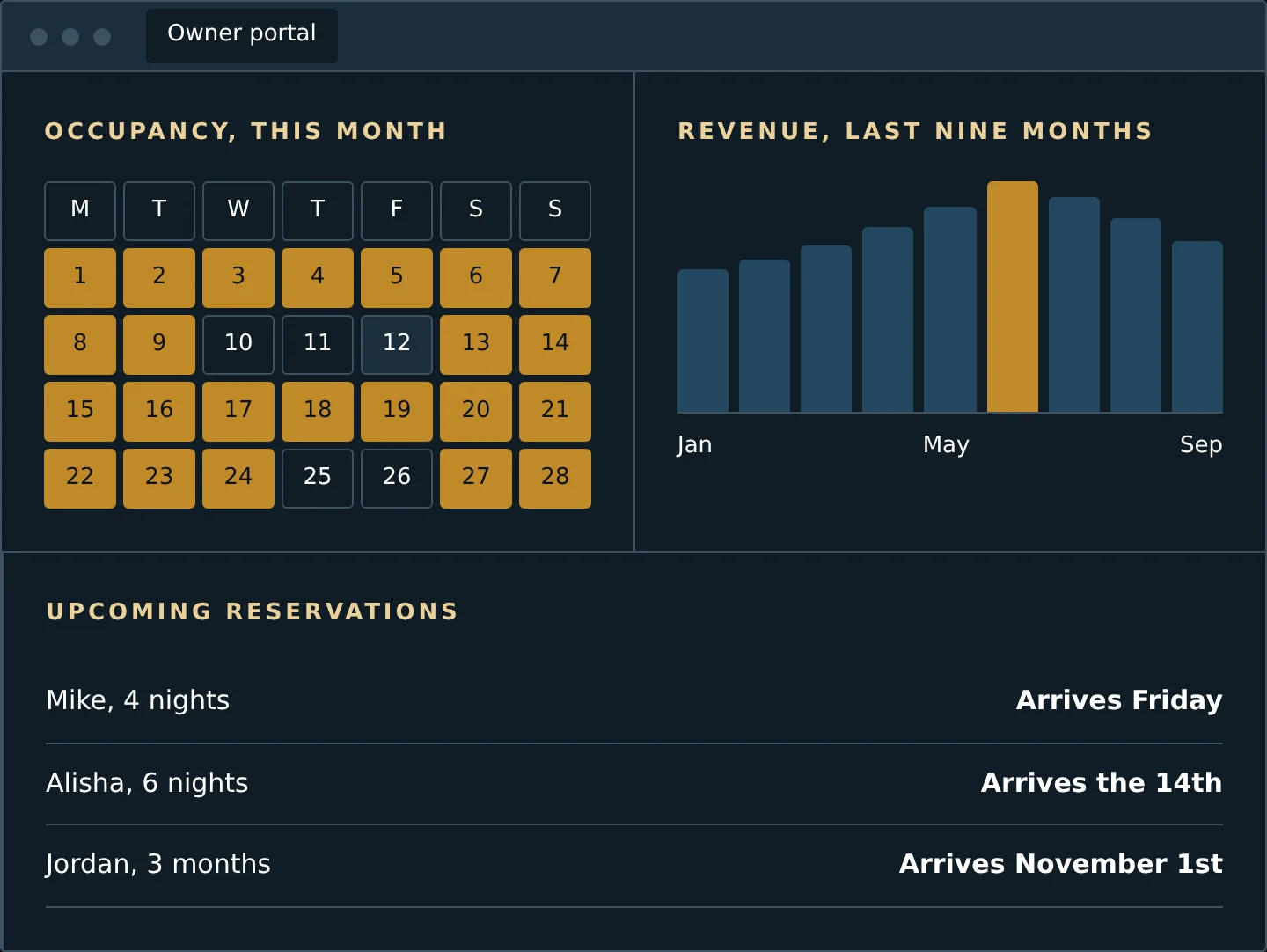
What is in it
- Upcoming reservations, as they are booked
- The occupancy calendar, live
- How the property is performing
- Revenue reports
- Your monthly owner statement
We run on Hostaway, which is what the channels connect to and what the calendar syncs through. The portal comes with the commission model. On the Fixed Income Model there is nothing to report against, because the amount does not move.
And one written statement a month.
An illustration of a typical month for a one-bedroom unit in downtown Toronto. Figures are an example, not a projection.
Booking revenue is paid to us by the channels and we remit one payment to you, so you are not chasing four platforms for four deposits and reconciling them yourself.
Who covers what
Written down before you get started rather than discovered in month three. The building's systems stay yours. The running of the place becomes ours.
You keep
- The refrigerator. Repair or replacement if it fails
- The dishwasher. Same
- The furnace. Heating is the owner's system
- The air conditioning. As above, and it matters more in July than you would think
- Repairs and replacements to any of those. We arrange the trade and supervise the work. The cost is yours
- The mortgage, taxes, condominium fees and insurance. As you would anyway
We cover
- Guest communication. First enquiry to checkout, including the two in the morning ones
- Cleaning coordination. Scheduled between every stay, with a photographed condition check
- Consumables. Coffee, paper, soap, the things that run out
- Minor touch-ups. So a scuff does not become a repaint
- Replacing what guests wear out. Shower curtains, linen, the small things that quietly age a unit
- Day-to-day operating cost. The running of the unit, not the fabric of it
The line is roughly this: if it came with the apartment, it is yours. If it is there because guests are, it is ours. Anything larger than a touch-up is quoted to you before it is booked, and how that is handled is written into your management agreement rather than left to custom.
Your property is listed and kept in sync across every channel that matters. One calendar, one set of rates, no double bookings.
Listed and synced on




Owner testimony
In their own words.



The one next step
One unit or forty, one straight answer.
Free eligibility review
About a minute to complete.
Goes to info@guestpoint.ca and nowhere else.